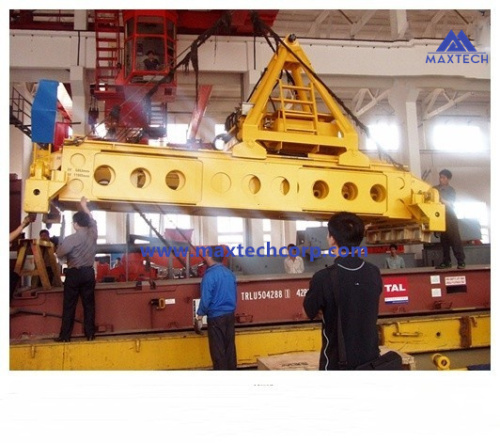
Maxtech has been at the forefront of the industry, specializing in providing comprehensive and professional technical and service support for container spreader systems. With our extensive expertise and commitment to excellence, we ensure the optimal performance, safety, and longevity of your container spreader operations.
Testing Services for Container Spreader
- Function Tests
- No-load Test: In the no-load state, maxtech meticulously examine the smoothness of all movements of the spreader, including lifting, lowering, telescoping, and rotating (if applicable). Our experts verify that the speeds of each action align with the design specifications, ensuring uniformity and the absence of any jamming or abnormal vibrations. Additionally, we conduct thorough checks on the sensitivity and reliability of the control system, including handles, buttons, and remote controls, to guarantee seamless operation without any interference between movements.
- Load Test: Using standard weights or actual containers, we perform load tests, gradually increasing the load to the rated lifting capacity. This enables us to observe the spreader's performance under real working conditions, closely inspecting for any deformations or cracks in structural components such as the main beam and hanger. Maxtech also test the convenience and reliability of the connection and disconnection between the spreader and the container, ensuring the twistlock device functions flawlessly.
- Tests for Safety Devices
- Limit Device Test: Maxtech technicians simulate the lifting and lowering movements to check the functionality of all limit switches, such as the lifting height limit switch, lowering depth limit switch, and telescoping limit switch. We ensure that these switches activate promptly when the set limit positions are reached, preventing any potential collisions and safeguarding the spreader and surrounding equipment.
- Overload Protection Device Test: By gradually increasing the load beyond the rated capacity, we verify the effectiveness of the overload protection device. Once triggered, it should immediately halt the lifting movement and emit an alarm, protecting the spreader from damage and averting potential safety hazards.
- Tests for Electrical System
- Insulation Resistance Test: Employing state-of-the-art insulation resistance testers, we assess the insulation resistance of all electrical components, including motors, controllers, and sensors. Our strict standards mandate that the insulation resistance values meet or exceed the specified thresholds, minimizing the risk of electric leakage and ensuring the safety of operators.
- Grounding Resistance Test: Maxtech conduct comprehensive tests on the grounding system to ensure it complies with safety regulations. A proper grounding resistance is crucial for diverting electrical current in the event of a fault, protecting both personnel and equipment.
- Test for Electrical Control Functions: Through detailed simulations of actual operations, we evaluate the performance of the electrical control system, testing functions such as forward and reverse control, speed adjustment, and interlock control. This ensures that the system responds accurately and reliably to all commands, enhancing the overall efficiency and safety of the spreader.
Precautions for Testing
- Safety First: At Maxtech, safety is our top priority. Before commencing any testing, we ensure the installation of prominent safety warning signs around the testing area, restricting unauthorized access. Our highly trained testers are equipped with all necessary personal protective equipment, and a dedicated safety supervisor is assigned to oversee the entire process. During load tests, we take extra precautions to ensure the stability of weights and containers, preventing any accidental slips or topples.
- Accuracy of Testing Equipment: Maxtech understand the importance of accurate testing results. That's why all our testing instruments, including dynamometers, limit switch testing tools, and insulation resistance testers, are regularly calibrated to the highest standards. This guarantees the reliability of our assessments and provides you with precise data on the performance of your container spreader.
- Operation in Accordance with Standards: Our testing procedures are strictly aligned with national and industry standards, as well as the equipment manufacturer's operation manuals. This ensures that every test is conducted in a consistent and reliable manner, minimizing the risk of damage to the spreader and maximizing the accuracy of our evaluations.
Daily Maintenance and Servicing Solutions for Container Spreader
- Maintenance of Mechanical Components
- Cleaning: We recommend a regular cleaning schedule, at least once a week, to keep the spreader free from dust, oil, and debris. Our team uses appropriate cleaning tools and agents, taking care to avoid any damage to the metal surfaces. During the cleaning process, we conduct detailed inspections of key areas, such as the main beam, hanger, and twistlocks, to remove any foreign substances that could impede the spreader's operation.
- Lubrication: Based on the spreader's usage and operating environment, we perform regular lubrication, typically every 1 - 2 weeks. Our experts apply the right type and amount of lubricant to all moving parts, ensuring smooth operation and minimizing wear and tear. We also monitor the lubricated components for any signs of abnormal wear, replacing parts as necessary.
- Inspection and Tightening: Monthly inspections are carried out to check the tightness of all mechanical connections, including bolts, nuts, and pins. Using calibrated torque wrenches, we ensure that all connections meet the required torque specifications, especially in critical areas such as the main beam and lifting mechanism connections.
- Maintenance of Electrical System
- Cleaning and Moisture-proofing: Every two weeks, we clean the electrical equipment to prevent dust accumulation and ensure proper heat dissipation. In humid environments, we implement advanced moisture-proofing measures, including the use of dehumidifiers and desiccants, to protect the electrical components from damage.
- Inspection and Maintenance: Our monthly electrical inspections cover all wire joints, plugs, and sockets, checking for looseness or oxidation. We promptly address any issues, replacing faulty components and conducting thorough functional tests to ensure the electrical system is operating optimally.
- Insulation Inspection: At least once a quarter, we perform insulation resistance tests on the entire electrical system, adhering to strict safety standards. If any insulation issues are detected, we identify the root cause and implement appropriate solutions, such as replacing damaged components.
- Anti-corrosion Treatment
- Surface Inspection: Monthly inspections are carried out to check for any signs of corrosion on the spreader's surface. In corrosive environments, we increase the inspection frequency and take immediate action to repair any damaged areas. Our repair process involves thorough cleaning and the application of high-quality anti-corrosion paint.
- Overall Anti-corrosion: Depending on the spreader's age and usage, we conduct comprehensive anti-corrosion treatments every 1 - 2 years. Using advanced techniques such as spraying or electroplating, we enhance the spreader's resistance to corrosion, extending its service life and maintaining its structural integrity.
At Maxtech, we are dedicated to providing you with the highest level of technical and service support, ensuring the reliability, safety, and efficiency of your container spreader operations. Trust us to be your partner in maintaining and optimizing your equipment for the long term.