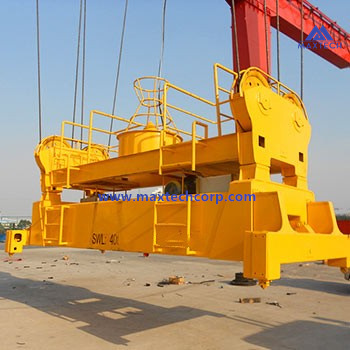
The following are some differences and comparisons between container spreaders in Chinese ports and those in ports of different countries.
Types and Structures
• China: Telescopic spreaders are commonly used. They drive telescopic chains or hydraulic cylinders through hydraulic transmission, automatically extend or retract to change the length, adapt to containers of different specifications, have strong versatility and flexible operation, and are widely used in major ports. There are also derived rotary spreaders, double-box spreaders, etc. based on this, which improve the operation efficiency and flexibility.
• Other countries: For example, some ports in the United States use movable double-box spreaders. A translation mechanism for the intermediate lifting point device is added on the basis of the double-box spreader, which can load and unload single or two 20ft containers with variable spacing within a certain range, and can better meet the lifting and transportation needs of different permutations and combinations of containers.
Technical Parameters
• Lifting Capacity: With the enlargement of container transport ships, the rated lifting capacity of container spreaders in Chinese ports has been continuously increasing. For example, the rated lifting capacity under the quay crane spreader provided by Zhenhua Port Machinery for a certain port in Oman can reach 65 tons, which is equivalent to the international advanced level and can meet the loading and unloading requirements of large container ships.
• Lifting Speed and Trolley Speed: The lifting speed and trolley speed of container cranes in some large ports in China have been continuously improved. For example, the lifting speed of the quay container crane of Shanghai Port Machinery Co., Ltd. can reach 60 m/min when fully loaded, and the trolley running speed can reach 240 m/min. However, compared with countries such as Japan, there are slight differences in the trolley speed for the medium-sized Panama ship type. The trolley speed in Japan is slightly higher than the normal level of ports around the world in some intervals of the medium-sized Panama ship type.
Degree of Intelligence
• China: In recent years, the intelligent development has been rapid. Many container spreaders in ports are equipped with sensors and intelligent control systems, realizing real-time monitoring of parameters such as weight, center of gravity, and wind speed during the lifting process, and being able to automatically adjust the working state of the spreader according to this information. They can also communicate with other equipment in the port, improving the automation level and safety of operations.
• Other countries: Some ports in countries such as Singapore and Germany adopted advanced automation and intelligent technologies earlier, realizing efficient loading and unloading and precise stacking of containers. Their intelligent spreaders are relatively mature in terms of collaborative operation with the terminal management system, and the overall operation efficiency is high.
Manufacturing and Quality
• China: After years of development, the manufacturing technology of container spreaders in China has been continuously improving. The product quality is reliable and has been exported to many countries and regions. The spreaders produced by some well-known domestic enterprises have reached a relatively high level in terms of structural strength, material selection, and manufacturing process, can meet the usage requirements of different ports, have a high cost-performance ratio, and possess strong market competitiveness.
• Other countries: Container spreaders produced by manufacturing powerhouses such as Germany are famous for their high quality and high performance. For example, the container handling tools of the German JUNG brand adopt high-quality materials and advanced manufacturing processes. The product quality is stable, the service life is long, and they are suitable for ports with high requirements for handling efficiency and safety, but the price is relatively high.