• China:
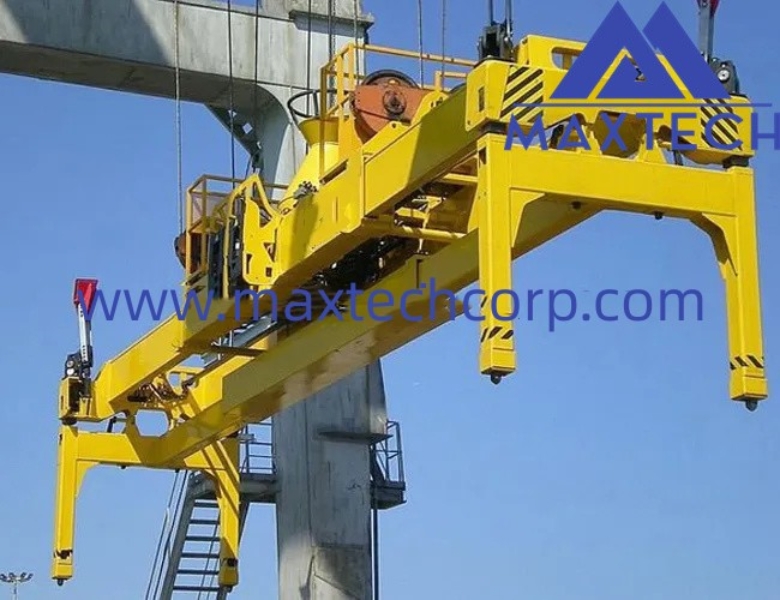
• The telescopic spreaders widely used in Chinese ports generally adopt high-strength steel, such as Q345B steel, to manufacture the frame to ensure structural strength. Its telescopic mechanism is mainly driven by a hydraulic system. For example, the telescopic spreader of Zhenhua Heavy Industries, its hydraulic system can precisely control the telescopic action. When switching between 20 - 40-foot containers, the telescopic action is rapid and smooth. The internal telescopic beams adopt a nested design. The outer beams and the inner beams are matched through high-precision guide rails and sliders to ensure accurate positioning during the telescopic process and can withstand the weight of the container and the impact force during the lifting process.
• In terms of electrical control, it is equipped with an advanced PLC control system, which can be seamlessly connected with the operating system of the crane. After the operator in the crane cab issues instructions through the operating handle or the automated control system, the telescopic instructions of the spreader can respond quickly, and the telescopic status of the spreader, including the telescopic length and whether it is in place or not, can be displayed in real time on the operation interface.
• Other countries (taking some European countries as examples):
• The telescopic spreaders used in some European ports may pay more attention to lightweight design in terms of structure. For example, they adopt a mixed structure of new composite materials and steel to reduce weight while ensuring strength. In terms of the hydraulic system, some high-end spreaders use hydraulic components with a higher pressure rating to make the telescopic action faster and more powerful. For example, the spreaders used in some ports in the Netherlands, the hydraulic system of their telescopic mechanism adopts advanced electro-hydraulic proportional control technology, which can automatically adjust the flow and pressure of hydraulic oil according to different load conditions to achieve more precise telescopic control.
• In addition, at the connection parts with containers, the spreaders manufactured in Europe may adopt a special lock head design. This kind of lock head has better sealing performance and higher reliability and can effectively prevent containers from falling off in harsh sea conditions or during long-term operations.
2. Twin-lift Spreader
• China:
• The twin-lift spreaders in China focus on practicality and efficiency in design. It usually adds the function of twin-lift on the basis of the telescopic spreader. For example, the twin-lift spreader produced by Shanghai Zhenhua Port Machinery Co., Ltd. has set up two sets of independent locking systems on the spreader frame through a reasonable structural layout. These two sets of locking systems can be controlled separately or simultaneously. When lifting two 20-foot containers, the two sets of locking systems can act synchronously and quickly lock the corner fittings of the containers.
• Its structural design also takes into account the adjustment of the spacing between the two containers. In order to adapt to containers arranged in different ways, the twin-lift spreader can adjust the distance between the two sets of locking systems through electric or hydraulic driving devices. The adjustment range is generally between 3 - 7 meters, which can meet the requirements of twin-lift operations in most port yards and ship loading and unloading.
• Other countries (taking South Korea as an example):
• The twin-lift spreaders used in South Korean ports have a relatively high degree of automation. The twin-lift spreaders developed by South Korean enterprises are equipped with an advanced visual recognition system, which can automatically recognize the positions, models and spacing of the two containers before lifting. For example, the twin-lift spreader used in Busan Port, its visual recognition system can be connected with the port's container management system to obtain container information, and then automatically adjust the position of the spreader and the spacing of the locking systems to achieve fast and precise twin-lift.
• In terms of structure, South Korea's twin-lift spreaders also focus on compactness and high efficiency. Its locking systems are made of high-strength alloy steel and have undergone special surface treatment to improve the wear resistance and corrosion resistance of the locking systems. Meanwhile, in order to reduce the shaking during twin-lift, the spreader is also equipped with a special anti-sway device, which stabilizes the containers during the lifting process through hydraulic dampers or mechanical linkage mechanisms.
3. Rotating Spreader
• China:
• The rotating spreaders in Chinese ports are mainly used in operation scenarios where the angle of containers needs to be adjusted. Its rotating mechanism is generally located in the center of the spreader and is driven by a motor - reducer combination or a hydraulic motor. For example, a rotating spreader used in Qingdao Port, its rotating mechanism adopts a high-torque hydraulic motor and can achieve a 360° rotation in the horizontal direction.
• The structural design of the rotating spreader also takes into account the stability and safety during the rotation process. High-precision slewing support bearings are set between the rotating platform and the spreader frame. These bearings can bear the weight of the container and the lateral force during the rotation process. Meanwhile, in order to prevent the cable from winding during the rotation process, the spreader is equipped with a special cable retracting and releasing device, which can automatically retract and release the cable according to the rotation direction and angle to ensure the normal operation of the electrical system.
• Other countries (taking Australia as an example):
• The rotating spreaders used in Australian ports have certain advantages in adapting to special working conditions. Since there is a large amount of bulk and general cargo mixed with container business in Australian ports, the rotating spreaders in Australia are more sturdy and durable in terms of structure. For example, the rotating spreader used in Sydney Port, its frame structure adopts thickened steel, and wear-resistant steel plates are used to reinforce the parts that are prone to wear.
• In terms of rotation control, the rotating spreaders in Australia may adopt more advanced wireless remote control technology. Operators can precisely control the rotation angle of the spreader at a certain distance through a handheld remote controller. Meanwhile, the remote controller can also display the rotation status of the spreader and other relevant information in real time, such as battery power and signal strength, which is convenient for operators to operate in complex working environments.