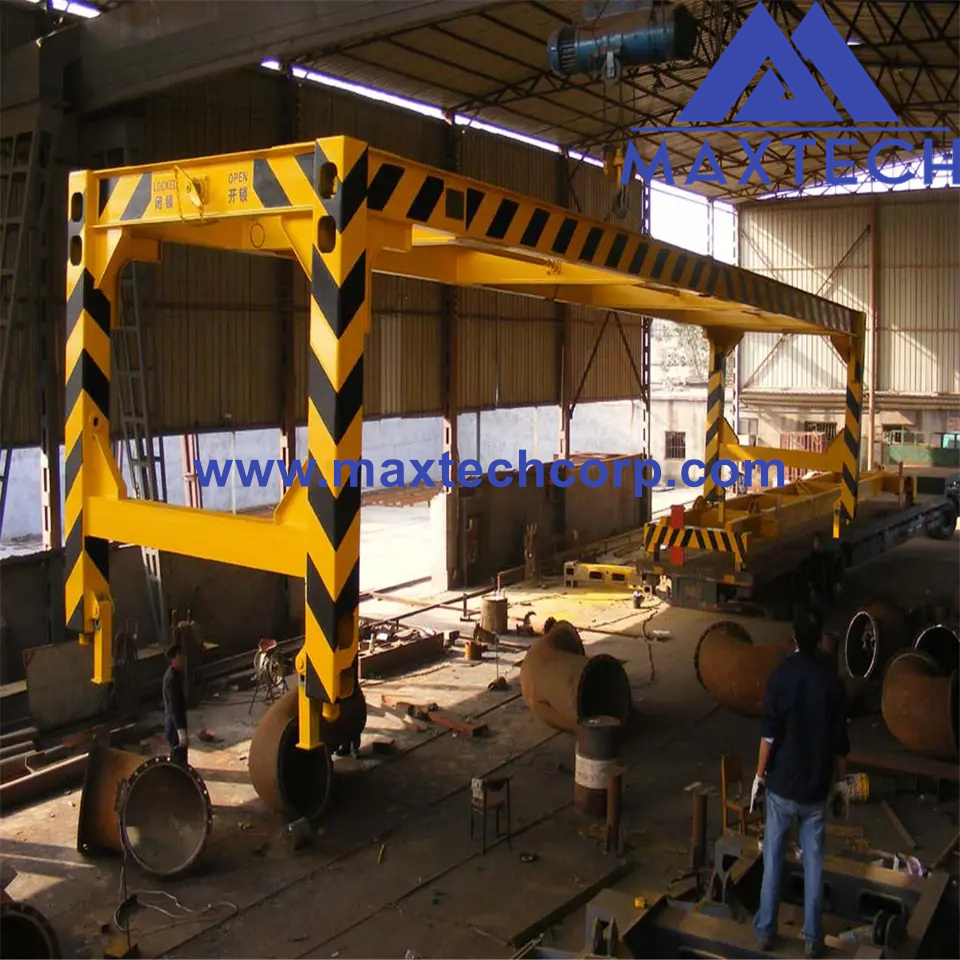
Application Scenarios of OHF Container Spreader
Port Terminals
It is used for loading and unloading standard 20-foot and 40-foot containers, as well as special containers that are higher or wider than normal. It can adapt to different ship types and terminal layouts, improving the handling efficiency.
Railway Freight Stations
In railway container transportation, it is used to lift or lower containers from railway flatcars, realizing the rapid transshipment and loading and unloading of containers.
Container Yards and Transfer Stations
It can be used for stacking, handling and sorting containers in the yard, facilitating the storage and management of containers. It can also be used for loading and unloading and transshipping containers at transfer stations to achieve the connection between different transportation modes.
Regarding the global sales situation of OHF container spreader, there is currently no exact and complete data available. However, according to the information released by Jiangsu Qunshuo Heavy Industry Equipment Co., Ltd. on Made-in-China.com, the price of its OHF container spreader ranges from US$6,000 to US$8,000 per piece, with a minimum order quantity of 1 piece and an annual production capacity of 300 sets.
Production Process of OHF Container Spreader
Design
Based on the specifications of containers, the lifting capacity, the working environment and other requirements, the structure of the MAXTECH spreader is designed and calculated to determine its external dimensions, material selection, connection methods and so on.
Material Procurement
High-strength steel, high-quality castings and forgings are selected as the main materials for the spreader to ensure its strength and durability. Meanwhile, various standard parts and accessories, such as twist locks, hydraulic cylinders, chains, pulleys, etc., are purchased.
Processing and Manufacturing
It includes processes such as cutting, welding, machining and heat treatment. The steel is cut into blanks to produce various parts of the spreader; the parts are assembled into an integral structure by welding; the key parts are machined to ensure dimensional accuracy and surface quality; some parts are heat-treated to improve their hardness and strength.
Surface Treatment
The outer surface of the spreader is treated with rust removal and oil removal, and then sprayed with anti-corrosion paint or galvanized to prevent the spreader from rusting and corrosion and extend its service life.
Assembly and Commissioning
The processed parts and purchased standard parts are assembled to form a complete spreader. During the assembly process, strict quality inspections and commissioning are carried out to ensure that all performance indicators of the spreader meet the design requirements.
Inspection and Testing
MAXTECH spreader is comprehensively inspected and tested, including non-destructive testing, mechanical property testing and functional testing. Non-destructive testing methods such as ultrasonic testing and magnetic powder testing are used to detect welds and key parts; mechanical property testing such as static load testing, dynamic load testing and fatigue testing are carried out on the spreader; the functions of the spreader such as expansion, rotation and locking are tested.
Packaging and Transportation
The MAXTECH spreader that has passed the inspection is packaged with appropriate packaging materials and methods to prevent it from being damaged during transportation and storage. Then it is transported to the location designated by the customer.